
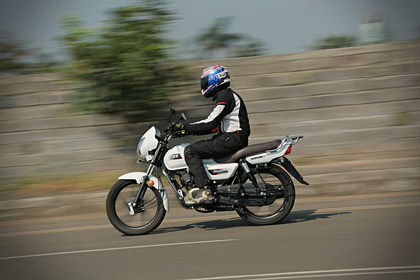
Every rider started somewhere. Before the confident rider who navigates city traffic without a second thought, before the tourer who covers 500 kilometres in a day with ease, before the enthusiast who can name every spec of every new model, there was a beginner sitting on a bike for the first time, quietly nervous, figuring out where the clutch bites and which brake does what.
That moment, the first time you actually ride, is one of the best feelings in motorcycling. And getting to that moment on the right bike makes everything easier, more enjoyable, and significantly safer. Choosing the wrong first bike, something too powerful, too heavy, too complicated, or just not suited to your size and confidence level, makes learning harder and can knock your confidence before it has a chance to grow properly.
This blog is a practical, honest review of some of the best beginner-friendly bikes available right now. We are going to look at what actually makes a bike suitable for someone who is new to riding, and then go through specific models that earn their recommendation, explaining what each one offers, who it is best suited to, and what to watch out for. At the end we will bring it all together so you can make a confident decision.
What Actually Makes a Bike Beginner Friendly
Before the specific reviews, it is worth being clear about what the phrase beginner friendly actually means in practice, because it is thrown around loosely in a lot of buying guides.
A beginner-friendly bike is not simply a slow bike. It is a bike that is forgiving of the mistakes that every new rider makes while they are learning. It is a bike where the consequences of a small error, a slightly mistimed gear change, a brake application that is a touch too sharp, a wobble on a slow-speed turn, are manageable rather than catastrophic.
Engine character matters here more than raw power numbers. A bike with a smooth, linear power delivery that builds gradually as you open the throttle is much more forgiving than one that delivers its power in a sharp surge. Even a relatively powerful engine can be beginner friendly if it delivers its power smoothly and progressively. Conversely, a bike with a peaky, aggressive power character can be difficult to manage even at moderate power levels.
Weight and physical accessibility are important practical factors. A bike that is too heavy to handle at low speed or when stationary, or one where the rider cannot comfortably get a foot down, creates stress in exactly the situations where new riders need to feel in control. Lighter bikes that sit low enough for the rider to touch the ground confidently reduce the anxiety around stopping and maneuvering that many beginners experience.
Ergonomics should allow a natural, upright riding position that does not put excessive strain on the wrists, back, or neck over a typical ride duration. Extreme forward-leaning sports positions and very low cruiser bars that put weight on the wrists are both harder to manage for long periods and less practical for the varied conditions a new rider typically encounters.
Ease of maintenance and spare parts availability in your local area matters because your first bike will almost certainly see more regular servicing needs than your bike later in your riding life as your technique refines. A bike from a well-supported brand with a dense service network and affordable parts makes ownership significantly less stressful.
Honda SP 160: Confidence Through Refinement
The Honda SP 160 represents everything Honda has learned about building reliable, accessible motorcycles and applying it to a bike that sits right at the sweet spot for beginner riders in India.
The 162cc single-cylinder engine delivers smooth, predictable power in a way that is easy to manage from the first day. There are no surprises when you open the throttle and no sudden power surges that catch you off guard. The engine is oil-cooled and well-proven, with Honda’s reliability reputation fully behind it.
The riding position is upright and comfortable, allowing natural arm and back positioning that does not fatigue a new rider over a typical commute or weekend ride. The seat height is accessible for a wide range of rider heights and the overall weight of the bike, at around 153 kilograms, is light enough to handle confidently at low speed.
Braking is handled by a disc front and drum rear combination with Honda’s combined braking system, which distributes braking force between both wheels when you apply the rear brake alone. For a new rider who is still developing brake feel and technique, this system provides an additional layer of safety that reduces the risk of the common beginner mistake of over-relying on one brake.
Fuel efficiency is genuinely good in real-world conditions, which keeps the running cost low during the period when you are still spending money on lessons, gear, and the general learning curve of owning a bike. The Honda service network in India is extensive and parts are affordable, making ownership straightforward.
Who is it best for: riders of average height looking for a smooth, reliable, and practical first bike with the confidence of the Honda brand behind it.
Royal Enfield Hunter 350: Character Without Intimidation
The Royal Enfield Hunter 350 has been a genuinely successful product since its launch and part of that success comes from attracting a demographic that Royal Enfield had not traditionally reached as effectively, younger, newer riders who want a bike with real character without the weight and presence of the Classic or Bullet.
The J-series 350cc single-cylinder engine is one of the best things about any Royal Enfield product right now. It is smooth for a single cylinder engine in this class, relatively refined, and delivers its power in the kind of relaxed, torquey way that is both enjoyable to ride and forgiving of imprecise technique. It is not a fast bike in absolute terms and that is entirely appropriate for a first machine. What it is, is a bike that feels good to ride even at sensible speeds, which is something not every entry-level option can claim.
The Hunter is lighter and more nimble than other Royal Enfield models, which makes it genuinely easier to handle in city traffic. The seat height is lower than the Classic and Meteor variants, which makes it more accessible for shorter riders. The weight is still on the heavier side compared to Japanese 150cc options but it never feels unmanageable.
The riding position is relaxed and natural. The street scrambler styling gives it a look that many new riders find genuinely appealing, which matters because buying a bike you find beautiful makes you want to ride it more often and riders who ride more often improve faster.
The Royal Enfield community is a genuine benefit of ownership. Riding clubs, group rides, online forums, and a culture of shared enthusiasm around the brand give new Royal Enfield riders a social dimension to their first bike that adds significantly to the overall experience.
Who is it best for: new riders who want a bike with genuine character, good build quality, and a community around it, and who are willing to invest slightly more than the commuter segment demands.
TVS Raider 125: Smart, Sporty, and Very Manageable
The TVS Raider 125 has won considerable praise since its launch for being a 125cc bike that does not feel like a compromise. It has a sporty design that appeals to younger riders, a well-rounded feature set that includes a semi-digital instrument cluster and LED lighting, and performance that is genuinely adequate for city use and short highway stretches.
The 124.8cc single-cylinder engine produces a modest but sufficient output that is entirely appropriate for learning. The power delivery is smooth and the overall riding experience is uncomplicated in exactly the way a first bike should be. New riders do not need to be thinking about managing difficult power delivery while they are still learning to read traffic, judge distances, and develop brake and clutch feel simultaneously.
The Raider sits low and is light enough that getting it off the side stand, maneuvering in tight spaces, and handling slow-speed situations does not require significant physical strength. For smaller or lighter riders, this accessibility is a genuine advantage.
TVS has equipped the Raider with a connected features package that links to a smartphone app and provides basic data on riding performance, trip information, and service reminders. For a generation of riders who are comfortable with connected technology, this integration adds a layer of engagement that makes the ownership experience feel modern.
The price point of the Raider 125 is genuinely attractive, making it one of the more affordable ways to get on two wheels on a bike that does not feel cheap. TVS’s service network is well developed across India and parts are accessible and affordable.
Who is it best for: younger riders on a tighter budget who want a sporty-looking, feature-rich 125cc bike that is genuinely easy to learn on.
Bajaj Pulsar N160: Growing Room Built In
The Bajaj Pulsar N160 occupies an interesting position in the beginner conversation because it is arguably slightly beyond the most conservative definition of a starter bike, but it is included here because it represents a very sensible choice for riders who are confident they will stay on two wheels for the long term and want a bike they will not outgrow quickly.
The 164.82cc single-cylinder oil-cooled engine delivers more performance than the 125cc options reviewed above but does so in a tractable, manageable way that experienced Bajaj engineers have refined well. The power is accessible rather than aggressive and the bike rewards smooth riding technique rather than demanding it at the expense of control.
Dual-channel ABS is available on higher specification variants of the N160 and this is worth the additional investment for a new rider. ABS prevents wheel lockup under hard braking, which is a common cause of falls for inexperienced riders who have not yet fully developed their braking technique. It does not make braking lazy but it provides a genuine safety net in moments of emergency.
The build quality on recent Bajaj products has improved noticeably and the N160 specifically feels like a properly engineered motorcycle rather than a budget option. The instrument cluster is informative without being overwhelming, the riding position is sporty but not extreme, and the overall fit and finish gives the bike a premium feel for its price.
Running costs are reasonable, the Bajaj service network covers the country comprehensively, and the Pulsar community online is active and helpful for new riders seeking advice.
Who is it best for: new riders who are slightly older, physically confident, and planning to stay on bikes for the long term, who want something with genuine performance potential alongside learner-appropriate manageability.
Suzuki Access 125: The Scooter That Earns Its Reputation
Not every beginner wants or needs a gearbox. Scooters are genuinely excellent first two-wheelers for many riders, particularly those who ride primarily in cities, carry work bags or shopping regularly, and value ease of use above all else. In the scooter category, the Suzuki Access 125 has earned a strong reputation that is worth reviewing honestly.
The Access 125 has a smooth, refined 124cc engine that is effortless in everyday use. There is no clutch to manage, no gear changes to time, just throttle and brakes. For riders who are nervous about gearbox management while simultaneously learning everything else about riding in traffic, this simplicity genuinely reduces cognitive load and allows more attention to go to road awareness and positioning.
The seat is wide and comfortable, the underseat storage is generous and genuinely useful for daily errands, and the overall build quality carries Suzuki’s reputation for reliability. The riding position is upright and natural with excellent visibility. The Access 125 runs on 12-inch wheels, which are slightly larger than some competitors and provide slightly more stability at speed.
Fuel efficiency is excellent at real-world numbers that keep monthly running costs minimal. The Suzuki service network is not as dense as Honda’s in all areas but is well-established in most cities.
Who is it best for: urban riders of any age who prioritise convenience, ease of use, and reliability, and who ride predominantly in city conditions.
Conclusion
Choosing your first bike is one of the most genuinely exciting decisions you will make as a new rider and it deserves careful thought rather than an impulse purchase based on what looks best in the showroom.
The bikes reviewed in this blog cover a range of needs, budgets, and riding styles, but they share the characteristics that matter most for someone who is starting out. Smooth and forgiving power delivery, accessible ergonomics, manageable weight, strong reliability records, and service networks that make ownership straightforward.
If your budget allows and you want a bike with real long-term character, the Royal Enfield Hunter 350 is a compelling choice that will grow with you as a rider. If you want the reassurance of the most trusted name in affordable motorcycles, the Honda SP 160 delivers reliability and refinement in equal measure. If you are budget-conscious and want something sporty and connected, the TVS Raider 125 punches above its price. If you are thinking about staying on bikes for many years and want performance room to grow, the Bajaj Pulsar N160 with ABS is a smart investment. And if you want the purest everyday convenience for city riding, the Suzuki Access 125 is one of the best scooters at any price point.
The most important thing, more important than which specific bike you choose, is that you choose one that suits your actual size, your actual riding situation, and your honest confidence level rather than the one that impresses someone else. Every experienced rider you admire started on something sensible. Their skill came from riding, not from the bike they started on.
Get the right bike for where you are now. Ride it properly. Learn everything it has to teach you. And the more challenging bikes will still be there when you are ready for them.
Start well and everything that follows will be better for it.