
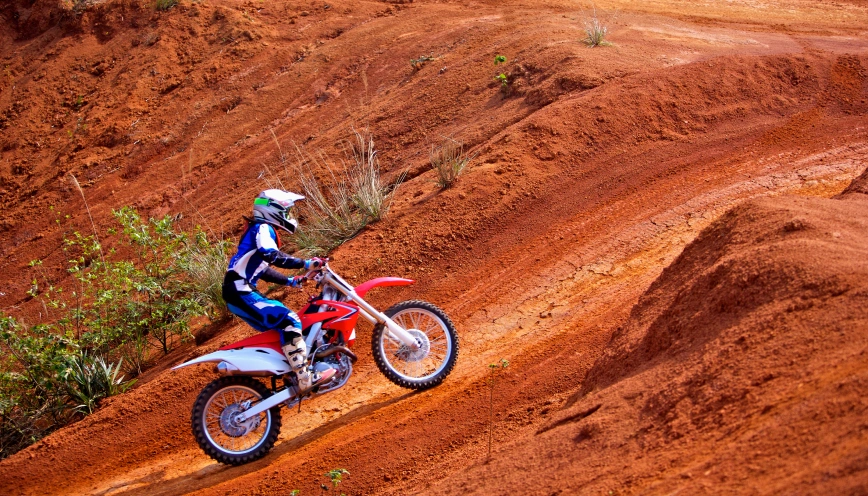
There is a particular kind of freedom that only exists when you are on a dirt bike, somewhere the road ends and the real terrain begins. No traffic signals. No lane markings. No smooth tarmac telling your tyres exactly what to do. Just you, the machine, and whatever the earth has decided to put in front of you. Rocks, mud, sand, roots, steep climbs and steeper descents, all of it asking something real from both the rider and the bike.
Off-road riding is genuinely different from road riding in ways that go beyond the obvious absence of pavement. The skills required are different, the physical demands are different, the relationship between rider and machine is more active and more demanding, and the rewards when you get something right are more immediate and more satisfying than almost anything available on a public road. It is no surprise that the community of people who ride off-road bikes across India and around the world is growing consistently as more riders discover what the dirt world has to offer.
This blog is going to cover dirt bikes and off-road riding in honest, thorough, practical detail. What different types of off-road motorcycles exist and what they are designed for. How to choose the right dirt bike for your level and your intended riding. What the essential skills are and how to develop them. What gear and preparation the discipline requires. The best places in India to experience off-road riding. And what the experience gives back to riders who invest in it seriously.
What Is a Dirt Bike and How Is It Different from a Road Motorcycle
A dirt bike is a motorcycle designed specifically for use on unpaved surfaces. The design priorities of an off-road bike are fundamentally different from those of a road motorcycle because the demands of unpaved terrain are fundamentally different from the demands of smooth tarmac.
Off-road motorcycles have long-travel suspension, which means the forks and rear shock can compress and extend through a much greater range than road bike suspension. This long travel is what allows the bike to absorb the large and sudden impacts of rough terrain without transferring all of that force to the rider and without losing contact with the ground. Road bike suspension is calibrated for the relatively predictable and small-amplitude variations of tarmac surfaces. Dirt bike suspension needs to handle rocks, roots, sudden drops, and landings from jumps, all of which involve impact forces and wheel travel distances that would completely overwhelm road-bike suspension design.
The tyres on a dirt bike are knobby, with tall, widely spaced tread blocks that dig into loose and varied surfaces to provide traction. On tarmac these tyres provide much less grip than smooth or lightly textured road tyres because the small contact patches of the individual knobs make far less tarmac contact than a slick or road-tread tyre. On dirt, sand, mud, and gravel, those same knobs do their job by penetrating the surface and finding grip that a smooth tyre would simply slide on.
Off-road motorcycles are significantly lighter than road bikes of equivalent engine capacity because weight is the enemy of off-road performance. Heavy bikes are harder to manoeuvre through technical terrain, harder to pick up when they fall, harder to carry momentum through soft surfaces, and harder to control on steep climbs and descents. Manufacturers of serious dirt bikes go to considerable lengths to minimise weight through the use of lightweight frames, aluminium and composite components, and compact engine designs.
The riding position on a dirt bike is designed for standing. This is one of the most important distinctions between off-road and road riding and it is one of the most significant adjustments new off-road riders need to make. On rough terrain, standing on the foot pegs with slightly bent knees allows the rider’s legs to act as additional suspension, absorbs impacts through the body rather than transmitting them rigidly through a seated position, and provides the visibility and balance control that technical terrain requires. The pegs on dirt bikes are positioned and sized accordingly, and the handlebars are typically higher to accommodate the standing riding position.
Types of Off-Road Bikes: Understanding the Categories
The world of off-road motorcycles is not a single category but a spectrum of different machines optimised for different types of off-road riding. Understanding the distinctions helps enormously in choosing the right bike for what you actually want to do.
Motocross bikes, sometimes abbreviated to MX bikes, are purpose-built racing motorcycles designed for closed-circuit racing on purpose-built tracks. A motocross track features large jumps, bermed corners, whoops sections, and a surface that is groomed and maintained for racing. Motocross bikes are optimised for the specific demands of this environment. They are extremely light, produce significant power relative to their weight, and have suspension tuned for the predictable and high-speed demands of a groomed track. They do not have lights, indicators, or any of the equipment required for road use. They are typically not the best choice for trail riding because the suspension and power delivery tuned for track use can be overwhelming on natural terrain.
Enduro bikes are designed for enduro racing, which involves cross-country courses through natural terrain. An enduro motorcycle needs to be capable across a very wide range of conditions from tight technical single-track through forests to open fast sections and everything in between. Modern enduro bikes are more versatile than motocross bikes and closer in character to what a serious trail rider would want. They typically have lights and can be road-registered in most markets, though they are primarily designed for off-road use.
Trail bikes are the most accessible and most versatile category of off-road motorcycle and the category that makes the most sense for most riders who are entering off-road riding or who ride off-road as a hobby rather than as a competitive pursuit. A trail bike is designed to be manageable and enjoyable across a wide range of terrain and skill levels. The power delivery is accessible rather than aggressive. The suspension is plush enough to absorb rough terrain without the precision tuning required of a motocross or enduro race bike. The weight is manageable. In India, motorcycles like the Royal Enfield Himalayan, the Hero Xpulse 200, and the KTM 250 Adventure occupy the trail and adventure bike territory that bridges road and off-road capability.
Dual-sport motorcycles or adventure bikes are perhaps the fastest-growing category in the Indian market. These are motorcycles designed to be genuinely capable both on the road and off-road. They are road-registered, road-legal, and comfortable to ride on tarmac for long distances. They also carry sufficient off-road capability to handle unsealed roads, forest tracks, mountain paths, and light off-road terrain. For riders who want to do extended touring that includes both paved and unpaved sections, the dual-sport or adventure bike category provides the most practical solution.
Trials bikes are a specialist category designed for observed trials competition, which involves riding through a series of very technical sections of terrain at extremely low speeds without putting a foot down. A trials bike has almost no seat because the rider stands for the entire time, extremely precise throttle and clutch control, and suspension designed for the specific demands of technical low-speed manoeuvring rather than for speed or impact absorption. Trials riding develops extraordinary balance and machine control skills that transfer positively to every other type of riding.
Choosing Your First Dirt Bike: The Decisions That Matter
The choice of a first dirt bike has significant consequences for how quickly you develop as a rider and how much you enjoy the experience in the early stages. Getting it wrong tends to produce either a bike that is too powerful and intimidating for the rider’s current skill level or a bike that the rider quickly outgrows and sells at a loss to fund the bike they should have bought first.
Engine size is the most commonly discussed variable in dirt bike selection but it is not the most important one for beginners. A 250cc four-stroke trail bike is an excellent starting point for most adult beginners because it produces accessible, manageable power that builds confidence while still providing enough performance to remain engaging as skills develop. 125cc bikes are also valid starting points, particularly for younger riders or smaller-framed adults. The common mistake of starting on a 450cc motocross bike or a powerful enduro machine because it seems more capable almost always results in a less enjoyable and less safe learning experience than starting on something appropriately sized.
Two-stroke versus four-stroke is a distinction that generates strong opinions in the off-road community. Two-stroke engines produce power with a distinctive sharp, strong hit in the upper rev range and a lighter, simpler engine that is easier to rebuild. Four-stroke engines produce power more progressively across a wider rev range, are generally more accessible for beginners, and are currently the dominant technology in the off-road market. For first-time off-road riders, a four-stroke is almost always the more appropriate choice.
Bike weight matters more for off-road than for road riding because you will drop the bike and you will need to pick it up. You will manoeuvre it through tight terrain where body English and pushing the bike with your legs matter. A bike that you can pick up when it falls is a better first dirt bike than a bike that requires two people to lift. This is a genuine and practical consideration that should influence the decision for lighter or less physically powerful riders.
The service network and parts availability for a dirt bike are practical considerations that matter in the real world of regular riding. A bike that is hard to get parts for or that requires specialist knowledge to service creates ongoing frustration. In India, Royal Enfield, Hero, KTM, and Bajaj all have substantial service networks that make ownership practical. Imported specialist brands may offer superior performance but their ownership in India involves greater complexity and cost in servicing and parts.
Essential Dirt Bike Skills: Learning to Ride Off-Road
The skills required for off-road riding are genuinely different from road riding skills and they take deliberate practice to develop. Understanding what those skills are helps new off-road riders focus their learning effort where it will produce the most improvement.
Standing position is the foundation skill of off-road riding and the one that new riders most frequently resist because it feels unfamiliar and initially unstable. Standing on the foot pegs with knees slightly bent, body weight centred over the bike, and a light grip on the handlebars allows the dirt bike’s suspension to work properly and allows the rider’s body to absorb impacts rather than transmitting them rigidly through a seated position. Riders who insist on sitting through rough terrain discover quickly that both they and the bike cope less well with rough terrain in a seated position.
Throttle control on off-road terrain requires more sensitivity and more awareness of traction conditions than road riding. The surfaces that off-road bikes operate on provide varying levels of traction that change constantly. Sand grips differently from wet clay, which grips differently from rocky hardpack, which grips differently from loose gravel. Learning to modulate throttle input in response to the available traction, opening it progressively rather than abruptly, is fundamental to maintaining control and momentum in varied off-road conditions.
Braking technique on off-road bikes is different from road braking because the available traction is lower and more variable. Locked wheels on off-road terrain are sometimes acceptable and sometimes the correct technique, which is very different from road riding where a locked wheel almost always represents a loss of control. Learning to use the rear brake to manage speed and use it as a deliberate tool for trail braking into corners, while using the front brake more progressively than on the road, is a skill that takes specific practice on off-road terrain.
Body position in corners on off-road bikes involves weight positioning that is specific to the surface and the type of corner. Bermed corners where the surface curves inward allow a more committed lean. Off-camber corners where the surface tilts away from the turn require deliberate weight placement to maintain traction. Loose surface corners require a more upright body position with the bike slightly more upright than feels natural. Each of these requires practice on actual terrain rather than being learnable purely from instruction.
Climbing steep sections requires commitment, momentum management, and the ability to shift body weight forward to maintain front wheel traction while keeping enough weight on the rear wheel for drive. Many beginners lose confidence mid-climb and stop, which is almost always the wrong outcome on a steep section because restarting on a steep uphill with limited space is significantly harder than committing through the climb. Building the confidence to commit to steep terrain comes with gradual progression from moderate to more challenging gradients.
Best Off-Road Riding Destinations in India
India is one of the richest countries in the world for off-road riding and the variety of terrain available across the country means that riders of every skill level and preference can find environments suited to their riding.
Spiti Valley in Himachal Pradesh is the destination that serious off-road riders in India speak about with a specific kind of reverence. The combination of high altitude, challenging terrain, remote location, and extraordinary landscape creates an off-road riding experience that has few parallels anywhere in the world. The tracks through the valley, the passes that connect it to neighbouring valleys, and the river crossings that must be navigated on some routes all challenge rider skill in ways that develop off-road capability rapidly.
Ladakh is both a supreme adventure motorcycle touring destination and a significant off-road riding destination. The tracks that branch off the main road network into the higher valleys and toward the remote passes provide genuine off-road riding that rewards skill and preparation. The Zanskar Valley tracks, the routes into the Nubra Valley beyond the main road, and the approaches to Pangong Tso across country provide riding that is more challenging and more rewarding than the main routes.
The Western Ghats provide excellent off-road riding across multiple states including Karnataka, Kerala, and Maharashtra. The forest tracks, plantation roads, and hill terrain of the Ghats are excellent for trail riding at all levels of skill. The combination of lush landscape, technical but manageable terrain, and accessibility from the major urban centres of South India makes the Ghats one of the most practical off-road riding areas in the country for regular riding rather than special expeditions.
Rann of Kutch in Gujarat provides a completely different character of off-road experience. The salt desert terrain, the sand tracks, and the vast open spaces of this extraordinary landscape create off-road riding that is about speed, navigation, and dealing with soft and unpredictable surfaces rather than technical rocky terrain. The desert riding skills required here are specific and valuable and the landscape itself is one of the most extraordinary in India.
The Aravalli Range in Rajasthan provides accessible off-road terrain within reasonable distance of Delhi and the major cities of Rajasthan. Off-road riding events and group rides in this area have become a regular feature of the motorcycle community in North India and the terrain, while not as dramatic as the Himalayas, provides genuine skill development opportunities in a relatively accessible location.
Essential Gear for Dirt Bike Riding
Off-road riding requires specific protective gear that is different from road riding gear and that is essential rather than optional given the nature of dirt bike riding and the frequency with which even experienced off-road riders have small crashes.
A full-face off-road helmet with the distinctive peak and chin bar of the motocross helmet design is the fundamental protective item. Off-road helmets are designed differently from road helmets with better ventilation for the physical exertion of off-road riding, a chin bar that protects the lower face from impacts with terrain and handlebar, and a peak that shades the eyes from sun and deflects debris. Many off-road riders also use goggles rather than visors because goggles provide better protection from dust, mud, and debris while providing the field of view required for scanning terrain.
Motocross boots are significantly more protective than road motorcycle boots and are essential for off-road riding. The rigid construction of a proper off-road boot protects the ankle, shin, and foot from the impacts, twists, and compressions that off-road terrain and falling dirt bikes produce. The difference in protection between a proper motocross boot and even a sturdy road motorcycle boot is substantial and the cost of the boots is minimal compared to the cost of an ankle injury that proper boots would have prevented.
Off-road riding pants and jersey are designed for the physical demands of dirt bike riding with flexible construction that allows the full range of body movement required for off-road riding technique, ventilation panels that manage the significant body heat generated by active off-road riding, and integrated or compatible knee and hip protector pockets. Riding in off-road terrain without proper pants, using only jeans or regular trousers, provides minimal protection from the impacts and abrasions that minor off-road falls produce.
Knee and shin guards provide essential protection for the lower legs against impacts from the footpegs, the bike itself, and terrain features. Combined knee and shin protectors that cover both in a single item are practical for off-road riding where both areas are regularly exposed to impact risk.
Gloves specific to off-road riding provide grip on the handlebars during the sustained vibration and grip demands of rough terrain while protecting the hands from impacts, abrasions, and the heat of the sun on exposed skin. Motocross gloves are lighter and more flexible than road gloves because the physical activity of off-road riding makes heavier protection impractical.
The Community and Culture of Off-Road Riding
The off-road riding community in India has grown substantially over the past decade and the culture within it is one of the most welcoming and most genuinely helpful in motorcycling. Off-road riders share a knowledge that the riding they do involves genuine challenge and genuine learning and this creates a culture of mutual support that road riding communities sometimes lack.
Off-road riding events, from organised enduro races to social group trail rides and skills clinics, have proliferated across India and provide entry points for new riders to connect with experienced ones. The Hero Xpulse Rally, the Desert Storm, and numerous smaller regional events provide competitive and social off-road opportunities for riders of varying experience levels.
Online communities dedicated to Indian off-road riding are active and genuinely useful sources of information about terrain, routes, bike setup, and skill development. The willingness of experienced off-road riders to share knowledge with newcomers is a consistent feature of these communities and reflects the culture of the discipline at its best.
Conclusion
Dirt bikes and off-road riding offer an experience of motorcycling that is genuinely distinct from anything available on a public road. The combination of physical challenge, active skill development, extraordinary terrain, and the immediate, unfiltered feedback that off-road riding provides between rider input and machine response creates a riding experience that is deeply engaging and deeply satisfying in ways that road riding at legal speeds rarely delivers in quite the same way.
The off-road world is accessible to almost any rider who is willing to invest in appropriate equipment, appropriate training, and the humility that learning a new discipline always requires. Starting on the right dirt bike for your level, learning the fundamental skills before attempting challenging terrain, wearing proper protective gear every time you ride, and connecting with the off-road riding community to benefit from the knowledge of experienced riders are all parts of building a foundation that will carry you from beginner to confident off-road rider with the minimum of unnecessary difficulty and the maximum of genuine enjoyment.
India is an extraordinary country for off-road riding. The terrain diversity, from the high Himalayan passes to the lush Ghats to the desert of Kutch, provides off-road experiences that are genuinely world-class. The growing community of Indian off-road riders provides routes, events, knowledge, and companionship that makes the journey from beginner to experienced off-road rider richly supported.
The dirt awaits. The terrain is extraordinary. The bikes that can take you across it have never been better or more accessible. The community that rides them has never been more welcoming.
All that is needed is the decision to start. Get the right dirt bike, get the proper gear, find an open area of safe off-road terrain, and begin the process of discovering what you and a capable off-road motorcycle can do together when the road ends and the real riding begins.
It is one of the best decisions a motorcycle rider can make.